Data Contracts for Pipeline Teams: Fail the Producer, Not Just the Test
Schema plus SLAs as a contract owned by the producer — fail the write path when the grain or freshness breaks, instead of discovering it in a warehouse test after the fact.
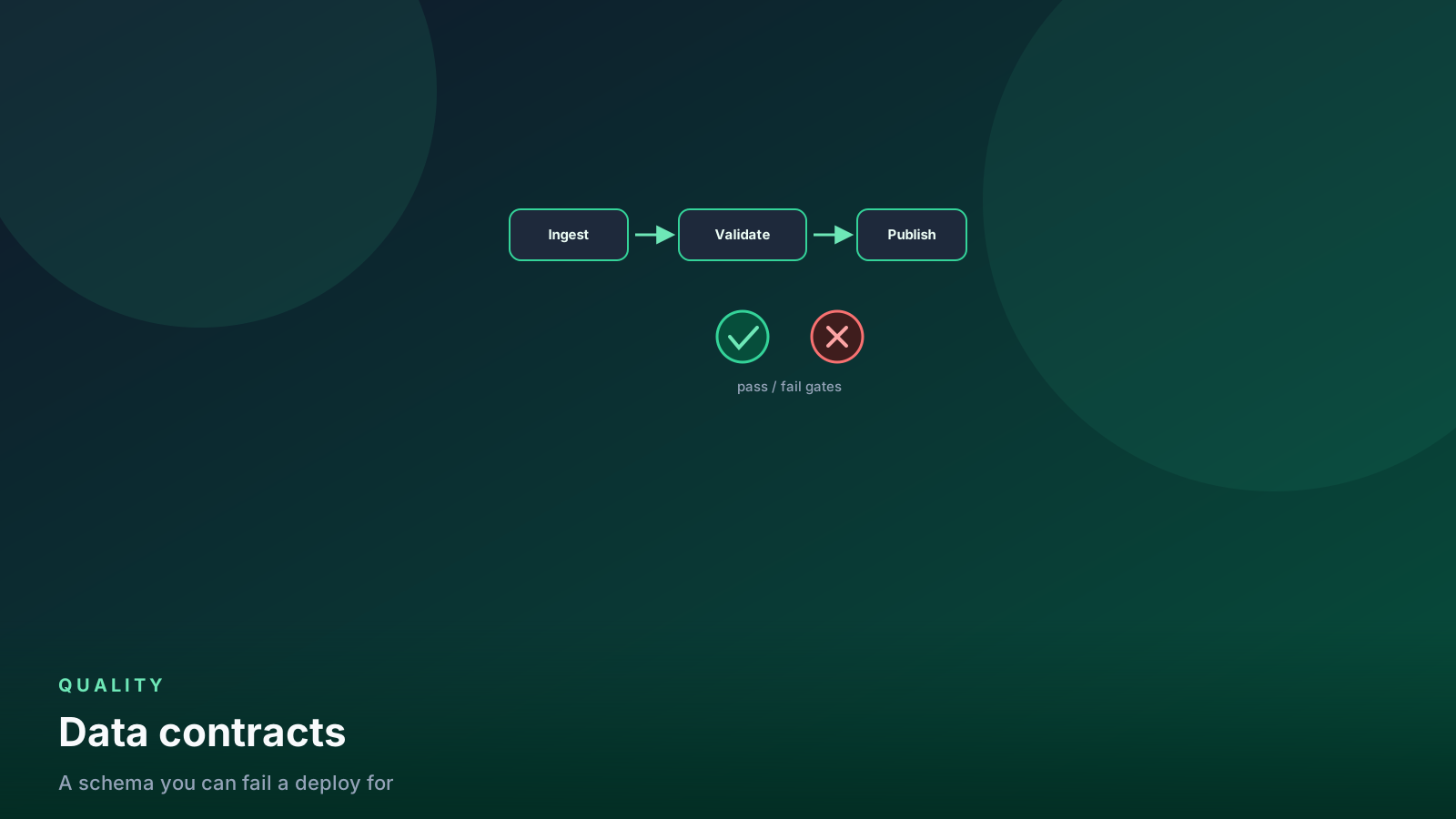
- ✓A contract is schema plus SLAs, owned by the producer.
- ✓Fail the write path. Warehouse tests are a second line, not the contract.
- ✓Version breaking changes. A silent rename is not an additive field.
- ✓Freshness and volume belong in the contract, not in a Slack habit.
- ✓Page the producer on breach. Do not only fail the consumer DAG.
Table of contents
A dbt not_null test failing on fct_orders at 7:00 AM is useful, but it is too late. The upstream engineering team already deployed their change, wrote bad data to Kafka or S3, and went to bed. Your morning pipeline crashed, the executive revenue dashboard is blank, and you have to spend your morning playing detective.
That’s the fundamental problem data contracts solve. A data contract moves the quality check upstream to the producer’s write path so bad data is blocked before it pollutes your lakehouse.
💡 The Restaurant Delivery Analogy (In Plain English)
Imagine a high-end restaurant receiving milk from a dairy farm:
- Traditional data pipeline (Late test): You dump the delivery into your mixing bowls, bake 200 pastries, and only when a customer bites into a sour croissant do you realize the milk was spoiled. Now you have to throw away all 200 pastries and apologize to furious customers.
- Data Contract (Upstream gate): The delivery driver arrives at the kitchen door. Before signing the receipt, your chef sticks a temperature gauge in the milk crate. If it’s warm or curdled, the driver takes it back right there. The dining room never suffers.
Producer Gate vs. Consumer Test: The Core Difference
| Aspect | Traditional Warehouse Test | Data Contract (Write Gate) |
|---|---|---|
| Where it runs | In your data warehouse / dbt run | At the API, microservice, or ingest script |
| When it runs | Hours later, usually 6:00 AM batch | Milliseconds before writing to table/topic |
| Who gets paged | Data Engineer (who didn’t make the bug) | Software Engineer (who wrote the buggy commit) |
| Business Impact | Broken dashboards, ruined trust | Bad deploy stopped before corrupting data |
flowchart LR
  prod[Software / Producer Team] --> gate{Data Contract Gate}
  gate -->|Passes Schema & SLA| land[Warehouse / Lakehouse]
  gate -->|Breach: Block write!| page[Alert Producer in CI/CD]
  land --> cons[Data Team / dbt Marts]
  cons --> tests[Secondary Warehouse Tests]
The data contract fails the write. Warehouse tests catch downstream logic bugs, but should never be the first alarm for bad upstream data.
Schema plus SLAs is the contract
A schema file without time is a type hint. Pipelines break on when and how much as often as they break on types.
A contract that is worth enforcing names:
- Grain — the business key and uniqueness.
- Schema — required columns, types, allowed nulls, enums.
- Freshness — max lag from event time or from the promised arrival clock.
- Volume — a band, not an exact count.
- Owner — a rotation that can stop the publish.
# contracts/orders_v1.yaml
name: orders
version: 1
owner: orders-platform
produces:
  uri: s3://lake/landing/orders/dt={ds}/
  format: parquet
schema:
  grain: [order_id]
  columns:
    - { name: order_id, type: string, required: true }
    - { name: customer_id, type: string, required: true }
    - { name: status, type: string, required: true, enum: [placed, paid, cancelled] }
    - { name: amount, type: float64, required: true, min: 0 }
    - { name: ordered_at, type: timestamp, required: true }
    - { name: updated_at, type: timestamp, required: true }
sla:
  arrival_by: "06:00"
  timezone: UTC
  max_lag_hours: 26
  min_rows: 1000
  max_rows: 5000000
compat:
  additive_columns: allow
  rename: breaking
  type_narrow: breaking
arrival_by is a clock SLA (the drop must exist by 06:00 UTC).
max_lag_hours is a data SLA (the newest updated_at cannot be
stale). You often need both. A file that arrives on time with
Tuesday’s leftovers fails freshness. A file that never arrives
fails the clock.
Load this YAML in the producer. Changing min_rows in chat is how
the contract becomes decoration — same rule as the quality-check
config in the Python post.
Fail the producer
The producer job validates before it publishes the partition
or commits the topic offsets. Failure means: no _SUCCESS, no
new consumer pointer, no “soft” write into gold.
from __future__ import annotations

from dataclasses import dataclass
from datetime import datetime, timedelta, timezone
from pathlib import Path

import pandas as pd
import yaml


class ContractBreach(Exception):
    pass


@dataclass(frozen=True)
class OrdersContract:
    grain: tuple[str, ...]
    required: tuple[str, ...]
    enums: dict[str, frozenset[str]]
    min_rows: int
    max_rows: int
    max_lag: timedelta
    arrival_by_hour: int


def load_contract(path: Path) -> OrdersContract:
    raw = yaml.safe_load(path.read_text(encoding="utf-8"))
    sla = raw["sla"]
    schema = raw["schema"]
    enums = {
        c["name"]: frozenset(c["enum"])
        for c in schema["columns"]
        if "enum" in c
    }
    return OrdersContract(
        grain=tuple(schema["grain"]),
        required=tuple(c["name"] for c in schema["columns"] if c.get("required")),
        enums=enums,
        min_rows=int(sla["min_rows"]),
        max_rows=int(sla["max_rows"]),
        max_lag=timedelta(hours=int(sla["max_lag_hours"])),
        arrival_by_hour=int(sla["arrival_by"].split(":")[0]),
    )


def assert_contract(df: pd.DataFrame, cfg: OrdersContract, now: datetime) -> None:
    failures: list[str] = []
    n = len(df)
    if n < cfg.min_rows:
        failures.append(f"volume {n} < {cfg.min_rows}")
    if n > cfg.max_rows:
        failures.append(f"volume {n} > {cfg.max_rows}")

    missing = [c for c in cfg.required if c not in df.columns]
    if missing:
        raise ContractBreach(f"missing columns: {missing}")

    for col in cfg.grain:
        if df[col].duplicated().any() or df[col].isna().any():
            failures.append(f"grain broken on {col}")

    for col, allowed in cfg.enums.items():
        bad = set(df[col].dropna().astype(str)) - allowed
        if bad:
            failures.append(f"{col} has values {sorted(bad)}")

    newest = pd.to_datetime(df["updated_at"], utc=True).max()
    if newest < now - cfg.max_lag:
        failures.append(f"freshness {newest.isoformat()}")

    if failures:
        raise ContractBreach("; ".join(failures))


def publish_if_ok(df: pd.DataFrame, cfg: OrdersContract, dest: Path) -> None:
    assert_contract(df, cfg, datetime.now(timezone.utc))
    dest.parent.mkdir(parents=True, exist_ok=True)
    df.to_parquet(dest, index=False)
    (dest.parent / "_SUCCESS").write_text("ok\n", encoding="utf-8")
No _SUCCESS means the
Airflow sensor
downstream does not start. That is the point. The consumer should
not be the first process that knows the drop is unusable.
Do not quarantine volume or freshness by dropping rows. Those are batch-level. You cannot reject “Monday never arrived” one row at a time. Quarantine is for messy-but-useful rows after the batch itself is a valid publish — see the quality-check post.
Warehouse tests are the second line
Keep dbt tests. Other jobs write. Humans run INSERT. Incremental
models drift. The contract does not make the warehouse omniscient.
What changes is who fails first and who is on the page:
| Breach | First fail | Page |
|---|---|---|
| Missing column, broken grain, empty weekday file | Producer publish | Producer owner |
| File never arrived by SLA | Producer SLA probe / sensor | Producer owner |
| Second writer broke uniqueness | dbt test on gold | Both, then fix writers |
| Consumer model joined wrong | Consumer CI | Consumer |
If only the consumer DAG pages, the producer learns about a rename from a Slack thread titled “fct_orders red.” That is not a contract. That is a courtesy.
-- consumer-side companion — still required
select order_id, count(*) as n
from analytics.marts.fct_orders
group by 1
having count(*) > 1
limit 20;
If that returns rows, a producer contract on today’s slice can still be green. Pair the layers. Incremental slices are unique while the target is not — leftover keys from last month.
dbt tests and source freshness belong next to models; the
dbt tutorial is the consumer
half. Put a freshness block on the source you do not own. Put
the publish gate on the job you do own.
Versioning: additive vs breaking
version: 1 is not a comment. Consumers pin it. Breaking changes
ship as v2 (new path, new topic, new schema registry id), with
a dual-write window if you cannot stop the world.
Additive: a new optional column. Old readers ignore it. New readers use it. Still document it.
Breaking: rename, type change, grain change, required field added without a default, enum value removed, partition clock changed.
def assert_compatible(old: dict, new: dict) -> None:
    if new["version"] < old["version"]:
        raise ContractBreach("version moved backwards")
    old_cols = {c["name"]: c for c in old["schema"]["columns"]}
    new_cols = {c["name"]: c for c in new["schema"]["columns"]}
    dropped = set(old_cols) - set(new_cols)
    if dropped:
        raise ContractBreach(f"removed columns {sorted(dropped)} require a new version")
    if old["schema"]["grain"] != new["schema"]["grain"]:
        raise ContractBreach("grain change is breaking")
    for name, col in old_cols.items():
        nxt = new_cols[name]
        if nxt["type"] != col["type"]:
            raise ContractBreach(f"{name} type {col['type']} -> {nxt['type']}")
Run that in the producer CI when the YAML changes. A PR that
renames amount to amount_usd without bumping the version
fails CI — not the next morning’s mart.
Do not “fix” a breaking change by making the consumer job
defensive (if 'amount' in df.columns). That trains the producer
to skip the version bump.
SLA probes are jobs, not vibes
A clock SLA needs a job that runs at arrival_by + a grace
minute and checks that the partition exists and passed the
contract. Absence is a producer failure.
def sla_probe(success_path: Path, cfg: OrdersContract, now: datetime) -> None:
    deadline = now.replace(
        hour=cfg.arrival_by_hour, minute=0, second=0, microsecond=0
    )
    if now >= deadline and not success_path.exists():
        raise ContractBreach(f"no publish at {success_path} after {deadline.isoformat()}")
Wire the probe in the same repo as the producer. The consumer
sensor waiting on _SUCCESS is a dependency edge, not the SLA
definition. If you only have the sensor, you have a timeout, not
a contract.
flowchart TD
  extract[Producer extract] --> validate[assert_contract]
  validate -->|ok| write[Write partition + _SUCCESS]
  validate -->|breach| pageP[Page producer]
  write --> probe[SLA probe at arrival_by]
  probe -->|missing| pageP
  write --> consumer[Consumer DAG]
  consumer --> dbt[dbt tests]
  dbt -->|other writers / drift| pageC[Page consumer + producer]
Publish, then probe the clock. Consumers start from _SUCCESS, not from hope.
Dual-write when you must bump
v2 is a new URI or topic, not a silent overwrite of v1. For a week (or a month — size it from consumer deploy time, not from optimism) the producer writes both paths after both contracts pass. Consumers cut over. Then you stop v1.
Do not dual-write “until someone remembers.” Put a calendar on the v1 path and a probe that still pages if v1 breaks during the window. Consumers still on v1 are why the old contract exists.
Schema Registry / Avro / Protobuf are the same idea with a central id: compatible evolution is additive; a grain change is a new subject. YAML in the producer repo is enough until you have more than a handful of publishers. Do not wait for a registry to fail the write.
When a contract is the wrong tool
- You do not know the schema yet (a vendor dump you are still profiling). Freeze rules after a week of observation, not on day one.
- There is no owner. A YAML file without a rotation is a wiki page.
- The pipeline is a one-off laptop pull.
len(df)is enough. - You are trying to enforce business definitions (what “revenue” means) across six marts. That is semantic modeling, not a landing-file contract. Keep the contract at the publish edge.
Pitfalls
- Tests only in the warehouse. The producer never fails. You discover the rename in BI.
- Exact row counts. They flap. Use a band. Holiday Tuesdays are not incidents.
- Contract in a Confluence page. The job cannot raise
ContractBreachon a paragraph. - Consumer owns the YAML. Then a breach becomes a consumer ticket. Put the file in the producer repo.
- Quarantining a missing file. There is nothing to quarantine. Fail the publish.
- v1 forever while columns rename. Compatibility CI exists so you bump to v2 on purpose.
Production checklist
- Contract YAML lives in the producer repo and is loaded by the publish job.
- Grain, required columns, volume band, freshness, and
arrival_byare explicit. - Publish writes
_SUCCESS(or commits offsets) only afterassert_contract. - SLA probe pages the producer if the drop is late or absent.
- Consumer DAGs wait on the success marker; they do not guess.
- dbt / warehouse tests remain for other writers and for gold grain.
- Breaking changes bump a version and a path. CI rejects silent incompatibilities.
- Alerts name the owner in the contract, not “data-platform” as a junk drawer.
FAQ
Why not only dbt tests? They run after the publish. The bad file is already in the lake and the consumer may have started. Fail the producer first. Keep dbt as the second line.
Who owns the contract file?
The team that writes the partition or topic. Consumers may
propose changes. They do not silently loosen min_rows to
make their DAG green.
Fail the job or quarantine the row? Fail the job on grain, schema, volume, freshness, and a missed SLA. Quarantine messy-but-useful rows only when the batch itself is a valid publish. Do not quarantine “Monday never arrived.”
When is a new column a new version? Optional additive columns can stay on v1 if old readers ignore them. Renames, type changes, grain changes, and new required fields without defaults are v2.
Where do checks run if we already use Great Expectations?
Same place: on the producer write path, before _SUCCESS.
The catalog of rules can be GX, Soda, or the YAML above. The
failure must stop the publish, not only decorate a report.
Quality checks tell you what to assert. A contract tells you when (before publish) and who (the producer). Put the gate on the write, page the owner named in the YAML, and leave warehouse tests in place for everyone else who can still write the table. That is the whole design. The rest is file format.
Senior Data & AI Engineer · SnowPro Core & Gen AI Certified
4+ years building production data platforms on Snowflake, Databricks, AWS, and Azure. I write from hands-on experience with Medallion architectures, dbt, Airflow, PySpark, and Snowflake Cortex AI. Every tutorial on this blog reflects real pipeline decisions — not documentation rewrites.
Read more about the author →