Databricks vs Google BigQuery: Lakehouse vs Serverless Warehouse
A pragmatic comparison: Databricks for Lakehouse/Spark/ML vs BigQuery for Serverless/SQL-native analytical workflows on GCP.
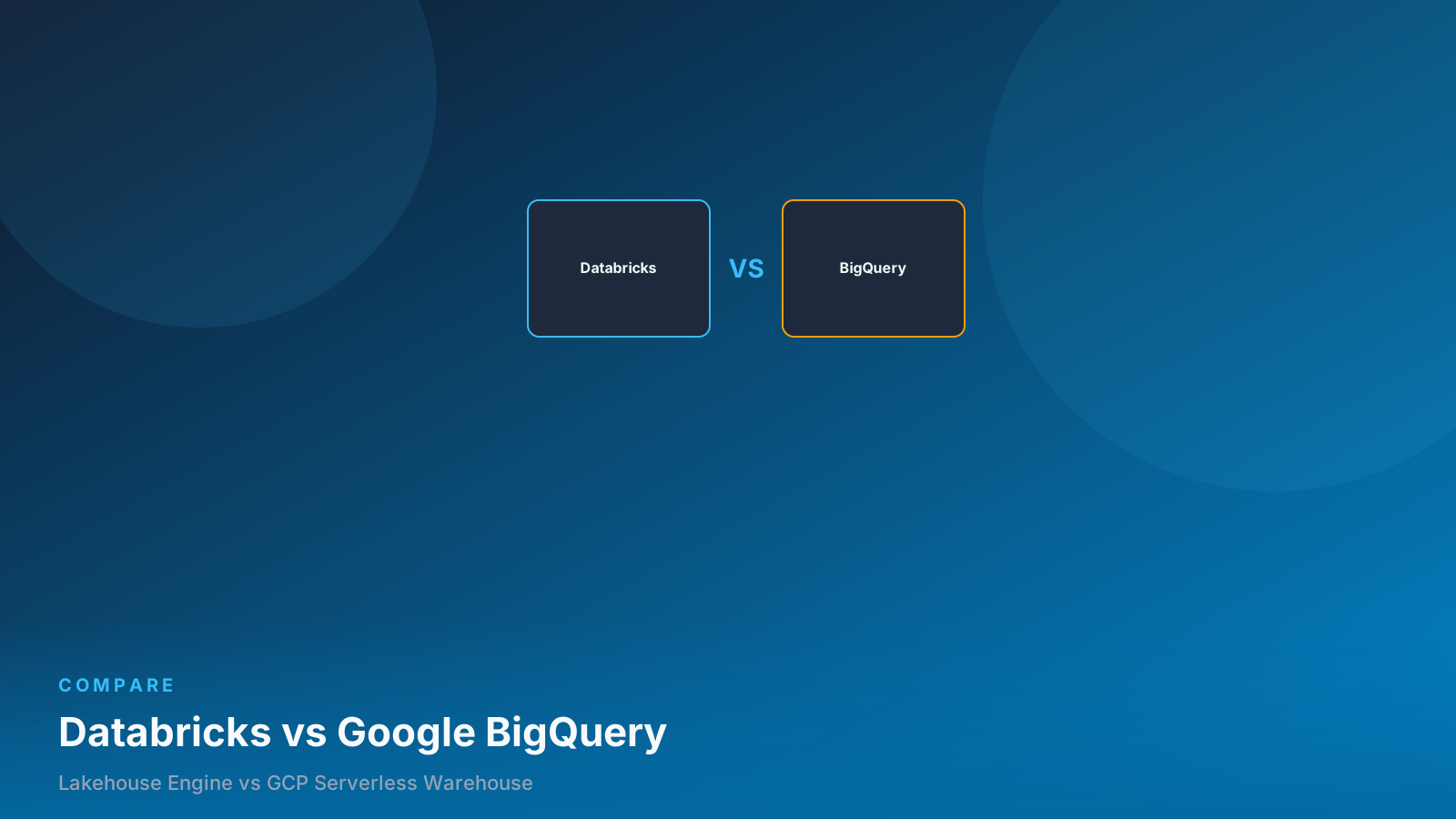
- ✓Databricks runs Spark on your own cloud infra (Lakehouse); BigQuery is a fully managed serverless warehouse.
- ✓BigQuery wins on simplicity: load data, write SQL, no infrastructure management required.
- ✓Databricks wins on extensibility: Python, ML models, and custom runtimes for complex pipe-lines.
- ✓Choose BigQuery for SQL-led analytics; Databricks for Python-led data engineering and ML.
Table of contents
The battle between Databricks and BigQuery is often framed as “Lakehouse vs Data Warehouse,” but for a modern data team on GCP, the choice is more about operational simplicity vs. architectural control.
The Core Philosophy
BigQuery: The Google Cloud Serverless Warehouse
BigQuery is built to abstract away everything: storage, compute, partitioning, and availability. You query, and Google gives you answers. You do not worry about instances, clusters, or workers unless you adopt BigQuery Editions slot reservations.
Databricks: The Lakehouse
Databricks is built on Apache Spark, running on your cloud infrastructure (or theirs managed). It forces you to think about the cluster: instance types, autoscaling, runtime versions, and executor memory. It gives you the “Lakehouse” pattern: the performance of a warehouse with the durability and openness of a data lake in Parquet/Delta.
When to Choose Which
| Feature | BigQuery | Databricks |
|---|---|---|
| Operational Effort | None (Serverless) | Moderate (Clusters/Autoscaling) |
| Primary Interface | SQL | Python (PySpark/Pandas) & SQL |
| Best For | BI, SQL-only Pipelines, GCP Native | ML, Complex Data Eng, Multi-cloud |
| Pricing Model | Bytes Scanned / Slots | DBUs + Cloud Compute |
The Cost Trap Comparison
BigQuery costs are transparent until they are not. An unoptimized SQL query (SELECT * on a multi-terabyte table) can spontaneously cost $100+. The cost is unpredictable, but per-query manageable via partitioning and clustering constraints.
Databricks costs are predictable. You pay for the cluster while it runs. If a job takes 10 minutes, you pay for 10 minutes of DBU + VM usage. The trap here is idle time — Databricks clusters kept running after a job finishes, or over-provisioned clusters that never scale down.
The Verdict
- Select BigQuery if: Your team is SQL-first, your data lives on GCP, and you want to spend your time writing business logic, not tuning Spark configurations.
- Select Databricks if: You are doing heavy ML/AI work, your pipelines require complex custom Python libraries, or you need to be multi-cloud neutral and keep your data in open Delta Lake formats.
Use our [[Cost Estimator|/compare/cost-estimator/]] to compare how your specific workload affects the monthly bill of both.
Senior Data & AI Engineer · SnowPro Core & Gen AI Certified
4+ years building production data platforms on Snowflake, Databricks, AWS, and Azure. I write from hands-on experience with Medallion architectures, dbt, Airflow, PySpark, and Snowflake Cortex AI. Every tutorial on this blog reflects real pipeline decisions — not documentation rewrites.
Read more about the author →