Cloud Data Warehouse Cost Comparison 2026: Snowflake, Databricks, BigQuery, and Redshift
A comprehensive TCO guide: pricing equations, real-world workload cost models, and how to use our interactive data stack cost estimator.
- ✓Cost varies wildly by price shape: per-second compute vs per-query scan vs per-DBU.
- ✓Storage is almost always the cheapest part of the bill—don't optimize for it at the expense of query performance.
- ✓Idle warehouses and full-table scans at scale are the most common invisible costs.
- ✓Use our [[Cost Estimator Tools|/compare/cost-estimator/]] to model how your specific volume changes the winner.
Table of contents
Choosing a cloud data warehouse is usually framed as a feature-set battle, but the decision is almost always finalised by the shape of the bill. Snowflake’s credit model for concurrency isolation looks nothing like BigQuery’s slot-based serverless model, which looks nothing like Redshift’s RPU-based serverless.
If your workload is bursty and ad-hoc, one model wins. If it is a 24/7 steady-state ingestion machine, another dominates.
This guide breaks down the pricing models for the four major players, explains how to calculate the true cost, and how you can simulate it for your workload using our [[Cost Estimator Tools|/compare/cost-estimator/]].
The Mental Models for Cost
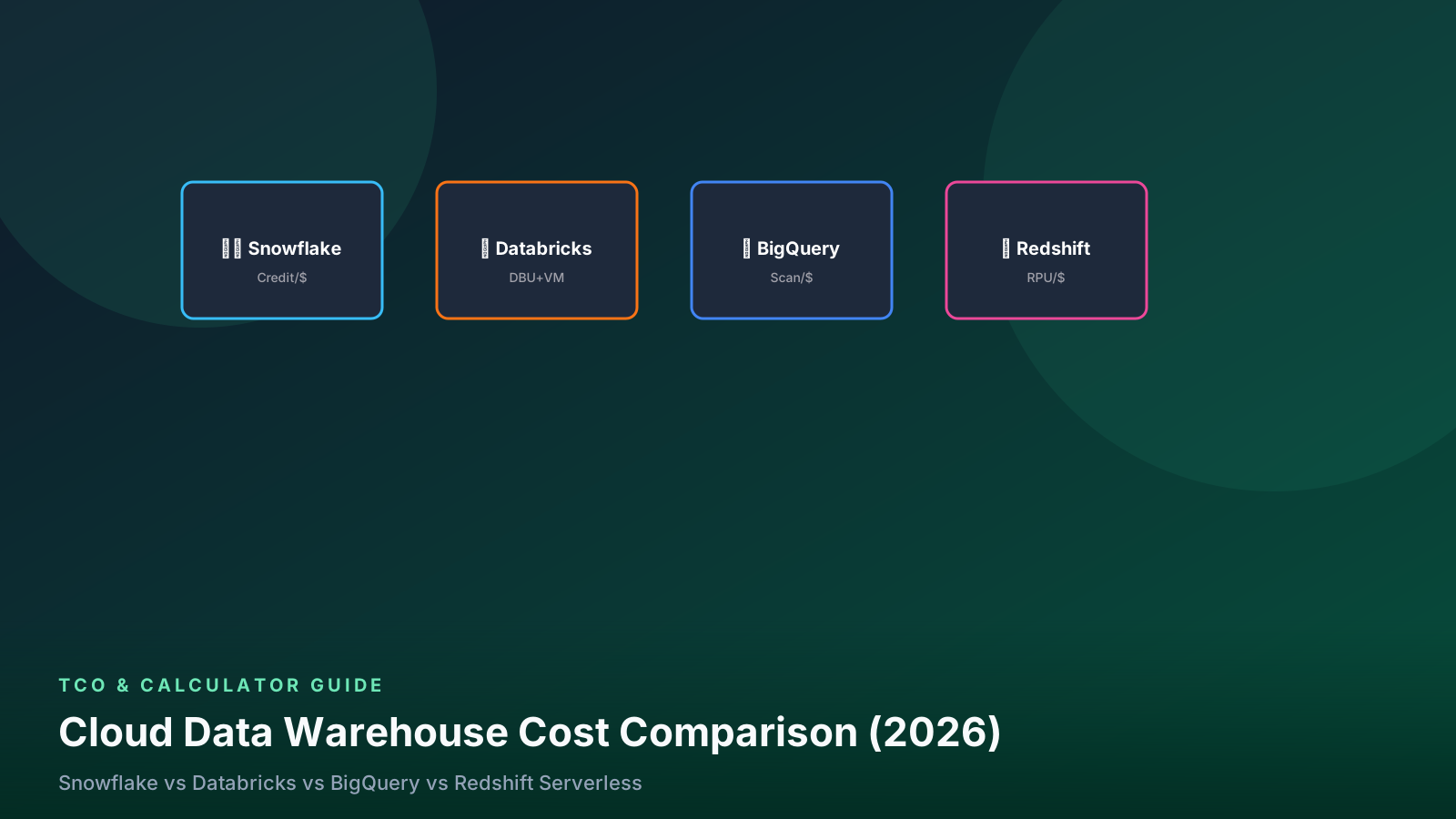
| Platform | Core Billing Metric | Optimizing for… |
|---|---|---|
| Snowflake | Credit per Second | Warehouse size (T-shirt), run time, auto-suspend |
| Databricks | DBU (plus Cloud VM) | Cluster uptime, instance types, caching |
| BigQuery | Bytes Scanned / Slots | Query optimization, partitioning, flat-rate vs on-demand |
| Redshift | RPU-seconds / Nodes | Reserved instances, concurrency scaling, WLM |
1. Snowflake: The Taxi Meter
You pay for every second the Virtual Warehouse (compute taxi) is running.
- Cost Traps: Oversized warehouse for small jobs, long auto-suspend intervals leaving the engine idling after query completion.
- Winning Workload: Mixed ad-hoc, BI, and ELT where concurrency isolation matters.
2. BigQuery: The Utility Bill
You pay for what you scan or the high-water mark of slots used.
- Cost Traps:
SELECT *on huge partitioned tables (full table scans). - Winning Workload: Bursty serverless, GCP-native integrations, minimal maintenance.
3. Databricks: The Lakehouse Engine
You pay for DBUs + the underlying Cloud VMs.
- Cost Traps: Leaving clusters running 24/7, choosing instances with higher specs than needed.
- Winning Workload: ML-heavy workloads, Spark-based pipelines, Delta Lake architecture.
4. Redshift Serverless: The AWS-Native Warehouse
You pay for RPU-seconds while active.
- Cost Traps: Misconfiguring concurrency scaling, not pausing clusters if not serverless.
- Winning Workload: Projects deeply integrated into AWS, predictable ETL windows.
How to Simulate Your Bill
Before you commit to a platform migration or sign a 3-year contract, model it.
Use our [[Interactive Cost Estimator|/compare/cost-estimator/]] to input:
- Daily Volume: How much data are you landing?
- Compute Hours: How long do your dbt/transformation jobs run?
- Warehouse Size: How big is the compute tail you need to turn over this data?
- Storage: How much do you keep in the Bronze/Silver/Gold layers long-term?
Try the simulator → [[Launch Cost Estimator|/compare/cost-estimator/]]
Senior Data & AI Engineer · SnowPro Core & Gen AI Certified
4+ years building production data platforms on Snowflake, Databricks, AWS, and Azure. I write from hands-on experience with Medallion architectures, dbt, Airflow, PySpark, and Snowflake Cortex AI. Every tutorial on this blog reflects real pipeline decisions — not documentation rewrites.
Read more about the author →