Kafka Exactly-Once Semantics: What Transactions Actually Guarantee
Idempotent producers, transactions, and read_committed give you exactly-once inside Kafka. The moment you write to a database, you still need an idempotent sink. Here is where the boundary sits.
- ✓Exactly-once in Kafka means exactly-once from Kafka to Kafka. It says nothing about your database.
- ✓Turn on the idempotent producer everywhere. It is free, on by default in modern clients, and kills the retry duplicate.
- ✓Transactions only help when the consume, process, and produce all live inside Kafka.
- ✓Every external sink needs its own idempotency key. A MERGE on a natural key beats a transaction you cannot join.
- ✓read_committed costs you latency equal to the slowest open transaction, not the average one.
Table of contents
- Three delivery guarantees, and the one you usually have
- The idempotent producer: turn it on and forget it
- Transactions: atomic produce plus offset commit
- read_committed is not free
- The sink is where duplicates actually get prevented
- What exactly-once costs
- Pitfalls
- FAQ
- Do I need transactions if my sink is already idempotent?
- Does exactly-once work across two Kafka clusters?
- How does this compare to Kinesis?
- What about Kafka Connect sinks?
- Can I get exactly-once with a file sink to S3?
- Is the throughput cost worth it?
- What this means for your pipelines
A staff engineer once told me his pipeline was exactly-once
because he had set processing.guarantee=exactly_once_v2 in his
Kafka Streams config. The topology consumed payments, enriched
it, and wrote each record to Postgres with an INSERT. The
Postgres table had 1.4 million rows against 1.39 million distinct
payment IDs.
He was not wrong about the config. He was wrong about the
boundary. Kafka’s exactly-once machinery is a closed system: it
covers records read from Kafka, state held in Kafka-backed stores,
offsets committed to Kafka, and records written back to Kafka.
Postgres is outside that system, and the transaction coordinator
has no idea that an INSERT happened.
That boundary is the whole subject of this post. I want to walk
through what the idempotent producer actually fixes, what
transactions add on top, why read_committed is not free, and
what you do at the sink — because in every real pipeline I have
built, the sink is where duplicates are actually prevented. If the
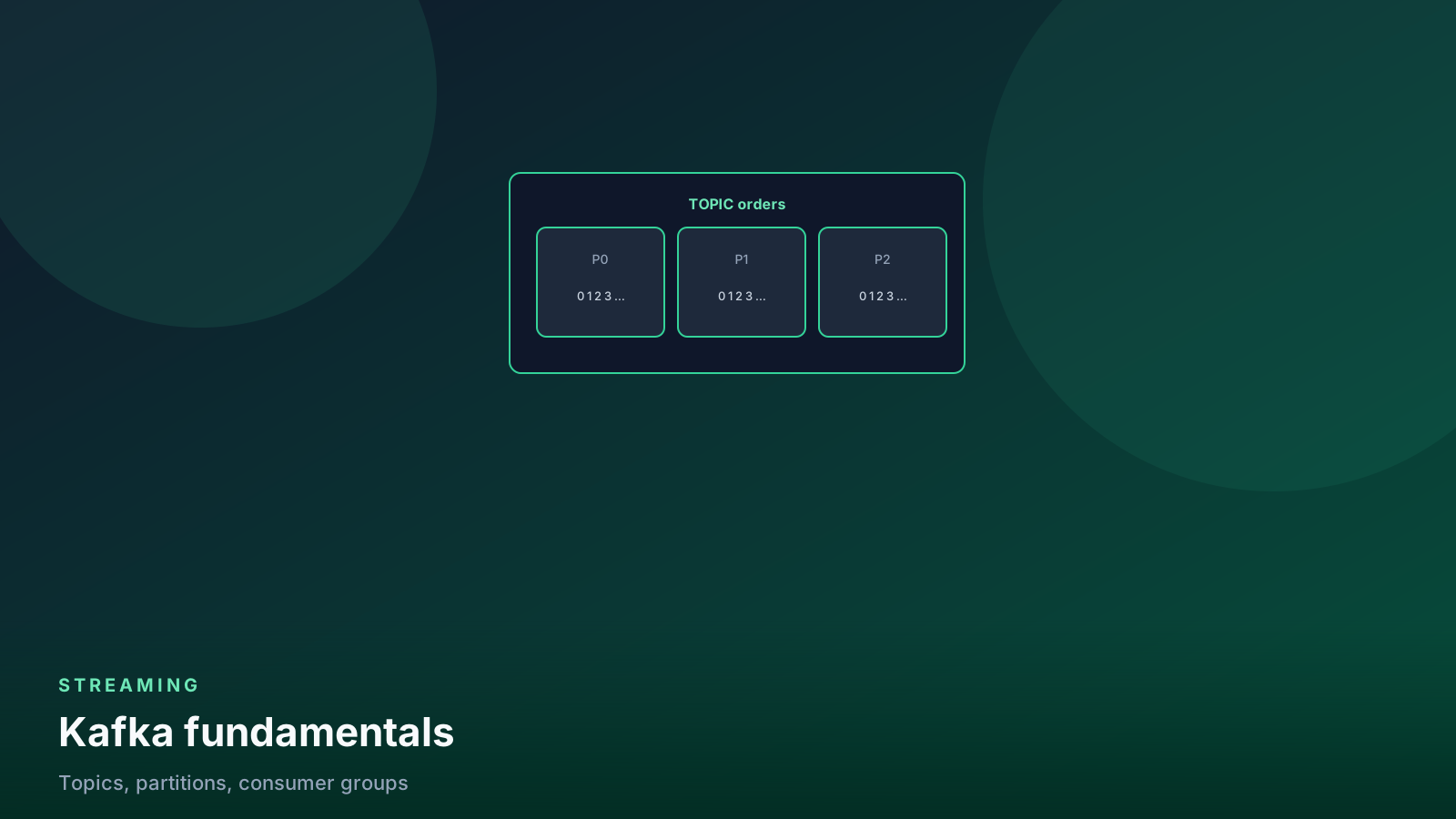
partition and offset model is still new, the
fundamentals post
comes first.
Three delivery guarantees, and the one you usually have
At-most-once: commit the offset before processing. A crash
loses records. Almost nobody wants this, but you get it
accidentally with enable.auto.commit=true and a slow sink.
At-least-once: process, then commit. A crash between the two replays records. This is the default posture of every consumer that commits after work, and it is the correct default.
Exactly-once: each record affects the output exactly one time, regardless of retries and crashes. Kafka delivers this for Kafka-to-Kafka flows via three mechanisms working together: sequence numbers on the producer, an atomic transaction spanning produces and offset commits, and a consumer isolation level that hides uncommitted data.
Notice what the third guarantee requires: the output has to be something the transaction coordinator can roll back. Kafka topics qualify. Your warehouse does not.
The idempotent producer: turn it on and forget it
Before transactions, there is a duplicate source that has nothing to do with your application logic. A producer sends a batch, the broker writes it and replicates it, and the acknowledgement is lost to a network blip. The producer retries. The broker writes the batch again. One send, two records, and no code you wrote is at fault.
The idempotent producer fixes this at the protocol level. Each producer gets a producer ID, each partition gets a monotonic sequence number, and the broker deduplicates any batch whose sequence it has already seen.
Properties p = new Properties();
p.put("bootstrap.servers", "b-1.msk.internal:9092");
// Default true in clients 3.0+. Set it explicitly so a config
// audit shows intent rather than a version-dependent default.
p.put("enable.idempotence", "true");
// Implied by idempotence, but be explicit: acks=all means the
// leader waits for all in-sync replicas before acknowledging.
p.put("acks", "all");
p.put("max.in.flight.requests.per.connection", "5"); // ordering is preserved up to 5
p.put("retries", Integer.MAX_VALUE);
p.put("delivery.timeout.ms", "120000"); // this, not retries, is the real bound
Two things worth internalizing. First, max.in.flight up to five
is safe only with idempotence enabled; without it, a retried
batch can land after a later batch and silently reorder your
partition. Second, retries is not the knob that bounds how long
a send can take — delivery.timeout.ms is. Setting retries to a
huge number with a sane delivery timeout is the correct
combination.
Also understand the scope: idempotence is per producer session,
per partition. If the process restarts and gets a new producer ID,
the broker cannot deduplicate against the previous session. That
gap is exactly what transactions with a stable
transactional.id close.
Transactions: atomic produce plus offset commit
A transactional producer wraps a set of produces and the offset commit for the records that caused them into one atomic unit. Both happen or neither does.
The pattern is consume-transform-produce, and the critical detail is that the offset commit goes through the producer, not the consumer:
producer.initTransactions(); // fences any zombie with the same transactional.id

while (running) {
    ConsumerRecords<String, Order> records = consumer.poll(Duration.ofMillis(500));
    if (records.isEmpty()) continue;

    producer.beginTransaction();
    try {
        for (ConsumerRecord<String, Order> rec : records) {
            Enriched out = enrich(rec.value());
            producer.send(new ProducerRecord<>("orders.enriched", rec.key(), out));
        }
        // The offsets are part of the transaction. This is the whole trick.
        producer.sendOffsetsToTransaction(
            offsetsOf(records), consumer.groupMetadata());
        producer.commitTransaction();
    } catch (ProducerFencedException | OutOfOrderSequenceException e) {
        // Another instance took over our transactional.id. We are the zombie.
        producer.close();
        throw e;
    } catch (KafkaException e) {
        producer.abortTransaction(); // consumer will re-read these offsets
    }
}
transactional.id must be stable across restarts and unique per
logical producer instance. On restart, initTransactions()
contacts the transaction coordinator, bumps the producer epoch,
and fences the old incarnation — any in-flight writes from the
previous process are rejected. That is how a hung-then-recovered
pod cannot corrupt the output.
The consumer in this loop must have enable.auto.commit=false.
If auto-commit is on, offsets move outside the transaction and the
atomicity is a fiction.
sequenceDiagram
  participant C as Consumer
  participant P as "Transactional producer"
  participant TC as "Transaction coordinator"
  participant T as "Output topic"
  C->>P: "Batch of 200 records"
  P->>TC: beginTransaction
  P->>T: "Write enriched records"
  P->>TC: "sendOffsetsToTransaction"
  P->>TC: commitTransaction
  TC->>T: "Write commit marker"
  Note over T: "read_committed consumers see records now"
Offsets ride inside the transaction. Nothing is visible downstream until the commit marker lands.
read_committed is not free
Producing transactionally is half the contract. The downstream
consumer must set isolation.level=read_committed, or it reads
aborted records as if they were real and the whole exercise was
theater.
read_committed consumers stop at the last stable offset — the
highest offset before the earliest still-open transaction. This
has a latency consequence that surprises people: a single
long-running transaction on a partition blocks visibility of
every record after it, including records from transactions that
already committed.
If your transaction commits every 100 ms, added latency is around
100 ms. If one consumer instance batches for 30 seconds before
committing, everything behind it waits 30 seconds. I size
transactions to commit at least every second, and I alert on
transaction.abort.rate because aborts leave markers that
consumers must skip.
transaction.timeout.ms (default 60 seconds, capped by the
broker’s transaction.max.timeout.ms) is the coordinator’s
patience. Exceed it and the transaction is aborted for you, which
you discover as a ProducerFencedException on the next send.
The sink is where duplicates actually get prevented
Now the part that matters for data engineering work. The moment the output goes anywhere other than a Kafka topic — Postgres, Snowflake, S3, Elasticsearch, an HTTP endpoint — the transaction coordinator is out of the picture. There is no two-phase commit between Kafka and your warehouse, and pretending otherwise is how you get 1.4 million rows for 1.39 million payments.
What works instead is making the write idempotent on a key the producer already guarantees. Then at-least-once delivery plus an idempotent sink equals effectively-once output, which is the property you actually wanted.
The natural key is best when the source has one:
-- Snowflake sink. order_id is the business key; the stream may
-- deliver the same record twice after a rebalance or a restart.
MERGE INTO analytics.raw.orders AS t
USING (
    SELECT
        order_id,
        customer_id,
        status,
        amount,
        updated_at,
        -- Keep only the newest version per key inside this batch.
        ROW_NUMBER() OVER (PARTITION BY order_id ORDER BY updated_at DESC) AS rn
    FROM @kafka_stage/orders/batch_2026_05_07_1412.parquet
    QUALIFY rn = 1
) AS s
ON t.order_id = s.order_id
-- Late-arriving replays must not overwrite newer state.
WHEN MATCHED AND s.updated_at > t.updated_at THEN UPDATE SET
    t.customer_id = s.customer_id,
    t.status      = s.status,
    t.amount      = s.amount,
    t.updated_at  = s.updated_at
WHEN NOT MATCHED THEN INSERT
    (order_id, customer_id, status, amount, updated_at)
VALUES
    (s.order_id, s.customer_id, s.status, s.amount, s.updated_at);
Two guards in there earn their keep. The QUALIFY rn = 1
deduplicates within the batch, because a replayed micro-batch
frequently contains the same key twice. The
s.updated_at > t.updated_at predicate makes the MERGE
order-independent — a replay of an older record leaves the table
alone instead of resurrecting stale state. That second condition
is the one teams forget, and it turns a correct-looking MERGE into
a time machine.
When the source has no natural key, synthesize a deterministic one from coordinates that never change for a given record:
import hashlib

def event_id(topic: str, partition: int, offset: int) -> str:
    """Deterministic per-record identity.

    Topic, partition, and offset uniquely identify a record for the
    life of the log, so a replay of the same record produces the same
    id and collides with the row already written.
    """
    raw = f"{topic}:{partition}:{offset}".encode()
    return hashlib.sha256(raw).hexdigest()[:32]


def write_batch(cur, topic: str, rows: list[dict]) -> int:
    """Insert with an idempotency key; duplicates become no-ops."""
    payload = [
        (event_id(topic, r["partition"], r["offset"]), r["key"], r["value_json"])
        for r in rows
    ]
    cur.executemany(
        """
        INSERT INTO events_raw (event_id, event_key, payload)
        VALUES (%s, %s, %s)
        ON CONFLICT (event_id) DO NOTHING
        """,
        payload,
    )
    return cur.rowcount
The offset-based key has one caveat: it is stable only if you never republish the same logical event to a new offset. For a compacted topic or a topic you replay into from a backfill job, use the business key instead. Whichever you pick, write it down in the data contract so the sink team and the producer team agree on what “the same record” means.
flowchart TD
  src["Source topic"] --> app["Consume + transform"]
  app --> out["Output topic"]
  out --> boundary{"Inside Kafka?"}
  boundary -->|yes| eos["Transactions + read_committed"]
  boundary -->|no| sink["External sink"]
  sink --> idem["MERGE or ON CONFLICT on an idempotency key"]
  idem --> table["Warehouse table"]
The dashed line in your head should be at the Kafka boundary. Transactions stop there; the sink takes over.
What exactly-once costs
Nothing here is free, and the cost is worth naming before you turn it on everywhere.
Idempotent producer: effectively zero. A few bytes of sequence metadata per batch. Turn it on universally.
Transactions: extra round trips to the transaction coordinator per
transaction, commit markers written into every partition you
touched, and a throughput hit that in my measurements runs
somewhere between 3% and 20% depending on how small your
transactions are. Small transactions cost more per record; large
ones cost latency downstream through read_committed.
read_committed consumers: added end-to-end latency equal to your
transaction duration, plus buffering of aborted records that get
discarded client-side.
Operational surface: transactional.id becomes part of your
deployment identity. Two pods sharing one ID will fence each other
in a loop. One pod per ID, derived from a stable ordinal, same
discipline as group.instance.id in the
rebalancing post.
Pitfalls
Believing exactly_once_v2 covers external writes. It covers
Kafka topics and Kafka-backed state stores. A JDBC call inside a
process() method is outside the transaction and will be executed
again on replay.
Producing transactionally while consumers read uncommitted.
The default isolation.level is read_uncommitted. If you do not
change it downstream, aborted records are delivered and you have
paid the transaction cost for nothing.
Auto-commit left on in a transactional consumer. Offsets then
move independently of the transaction, and a crash replays or
skips depending on timing. Set enable.auto.commit=false.
Reusing one transactional.id across instances. Each
initTransactions() bumps the epoch and fences the other one. Two
pods with the same ID produce a fencing ping-pong that looks like
a broker fault.
A MERGE without a recency predicate. Idempotent against
duplicates, but an out-of-order replay overwrites new state with
old. Always compare updated_at or a monotonic version.
Very long transactions to “reduce overhead”. You move the cost from producer throughput to consumer latency, and one stuck transaction blocks the last stable offset for every downstream reader on that partition.
FAQ
Do I need transactions if my sink is already idempotent?
Usually not. An idempotent producer plus at-least-once consumption plus an idempotent sink gives you the same observable outcome with less operational surface. I reserve transactions for topologies that read from Kafka and write back to Kafka, especially multi-topic fan-out where partial writes would be visibly inconsistent.
Does exactly-once work across two Kafka clusters?
No. A transaction is scoped to one cluster’s transaction coordinator. MirrorMaker 2 and most replication tools are at-least-once across clusters, so a cross-cluster pipeline needs sink-side deduplication regardless of what each cluster does internally.
How does this compare to Kinesis?
Kinesis has no transaction concept at all. You get at-least-once delivery and you build idempotency into the consumer, which is also how I would build a Kafka pipeline with an external sink. The broader trade-offs are in Kafka vs Kinesis.
What about Kafka Connect sinks?
Connect sink tasks are at-least-once by default. Some connectors
support exactly-once through upsert semantics on a configured key,
which is the MERGE pattern above wearing a config file. Check
whether your connector’s insert.mode is insert or upsert
before assuming anything; the details are in
Kafka Connect in production.
Can I get exactly-once with a file sink to S3?
Only by making the write atomic and named deterministically. Write to a temporary key, then copy to a final key derived from the topic, partition, and start offset. A replay produces the same final key and overwrites itself harmlessly. Appending to an existing object does not work.
Is the throughput cost worth it?
If both ends are Kafka and correctness matters more than 10% of throughput, yes. If either end is external, you are paying the cost and still need sink idempotency, so spend the effort on the sink instead.
What this means for your pipelines
Enable the idempotent producer everywhere today. It is on by
default in current clients, it eliminates a real duplicate source
that has nothing to do with your code, and it costs nothing. If
any of your producers are on an older client or explicitly set
enable.idempotence=false, that is a one-line fix worth shipping
this week.
Then draw the Kafka boundary on your architecture diagram and be
honest about where each pipeline crosses it. Kafka-to-Kafka
topologies — stream joins, enrichment chains, fan-out to several
downstream topics — are where transactions and read_committed
earn their overhead, and where Kafka Streams gives you the whole
thing behind one config value. Everything that terminates in a
warehouse, a search index, a cache, or an HTTP API is at-least-once
in practice no matter what the producer config says.
For those pipelines, put your effort into the idempotency key. Pick it deliberately, prefer a business key over a coordinate key, add the recency predicate so replays cannot rewrite newer state, and document it where both the producer and the consumer team can see it. A sink that is idempotent by construction survives rebalances, restarts, backfills, and the inevitable day someone replays a week of history to fix an enrichment bug. That resilience is worth more than any config flag.
Senior Data & AI Engineer · SnowPro Core & Gen AI Certified
4+ years building production data platforms on Snowflake, Databricks, AWS, and Azure. I write from hands-on experience with Medallion architectures, dbt, Airflow, PySpark, and Snowflake Cortex AI. Every tutorial on this blog reflects real pipeline decisions — not documentation rewrites.
Read more about the author →